
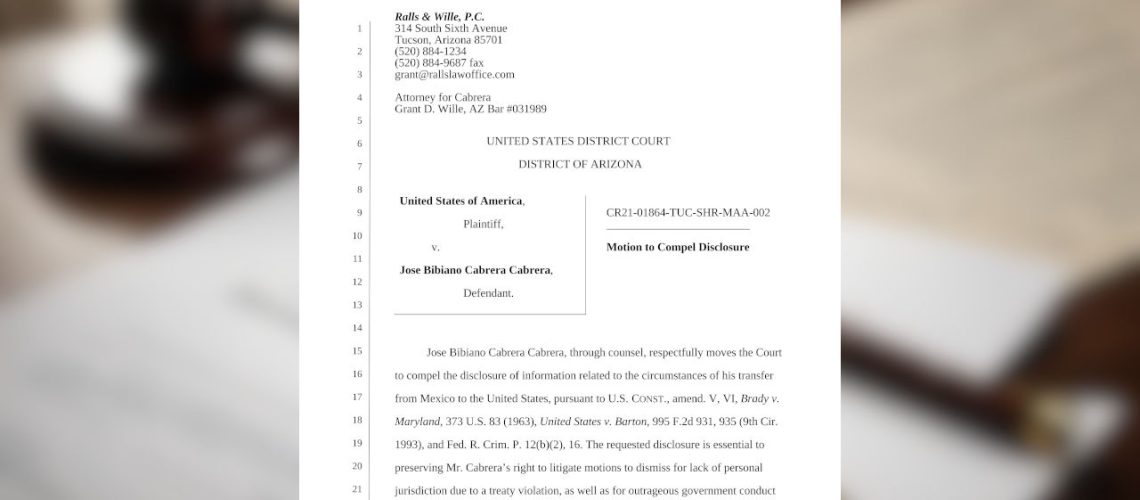
TUCSON, AZ — Criminal defense firm Ralls and Wille, P.C., filed a motion on August 4, 2026, to compel disclosure of communications and documents related to the Trump administration’s coordination with Mexican President Claudia Sheinbaum’s administration in 2025 through 2026. The coordination of these two governments led to Mexico handing nearly one hundred alleged cartel traffickers to the United States to face prosecution, circumventing the countries’ extradition treaty. One individual given to the United States government in this manner is Ralls & Wille’s client Jose Bibiano Cabrera‑Cabrera. If the motion is successful, the firm will likely obtain information on how the United States compelled Mexico to violate the treaty and its own court orders. This would be used to argue that the defendants were illegally turned over to the United States, potentially resulting in the dismissal of the criminal proceedings in the United States against Mr. Cabrera.
During the past two years, the Mexican government transferred a total of 92 individuals in three large groups of alleged drug traffickers to face prosecution in the United States. These transfers occurred on February 27, 2025, August 12, 2025, and January 21, 2026. Included in these transfers are well‑known defendants with cases still pending in the United States, including Rafael Caro Quintero, Vicente Carrillo Fuentes, Miguel Ángel Treviño Morales, Óscar Omar Treviño Morales, José Guadalupe Tapia Quintero, Carlos Alberto Monsiváis Treviño, and José Alberto García Vilano. Criminal cases remain pending against at least 65 transferred defendants in over 20 courts across the United States.
Ralls & Wille contends that these transfers represent an extraordinary breakdown in the rule of law. According to their motion filed in the District of Arizona on behalf of one defendant sent from Mexico to the United States, the Trump administration threatened Mexico with tariffs and military strikes to coerce the Mexican government into transferring defendants. In a press release, the White House initially characterized these transfers as extraditions pursuant to the 1978 U.S.‑Mexico Extradition Treaty, but other departments of the government later changed course and recharacterized them as “expulsions.” The inconsistencies in how the government has justified these transfers at different points could suggest that the federal government is attempting to obscure the nature of the transfers.
This pattern of coercive government behavior is consistent with broader actions by the Trump administration targeting alleged drug traffickers. The administration has conducted at least 22 lethal military strikes on vessels in the Caribbean, claiming to target narco-terrorists while refusing to release the secret Office of Legal Counsel opinion purporting to justify these strikes as lawful acts of war.
Only one other case involving defendants expelled from Mexico has touched on the issue raised by Ralls & Wille. In United States v. Cardenas‑Guillen et al, out of the U.S. District Court for the District of Columbia, defendant Miguel Trevino Morales filed a motion that raised similar challenges based on constitutional grounds and treaty violations. The court ruling on Trevino Morales’s motion ultimately denied the request to compel the federal government to produce documents on the communications between the United States and Mexican governments. The motion filed by Ralls & Wille will be heard by a different court. Lead attorney for Ralls & Wille, Grant D. Wille, believes that the new challenge has more rigorous legal briefing and supporting evidence that will better expose the violations underlying these irregular transfers.
Ralls and Wille, P.C. is actively pursuing this litigation and welcomes inquiries from counsel for defendants who are similarly situated and wish to challenge the legality of their transfer to U.S. custody. Individuals interested in joining or coordinating on this matter are encouraged to contact the firm.
 ES
ES  English